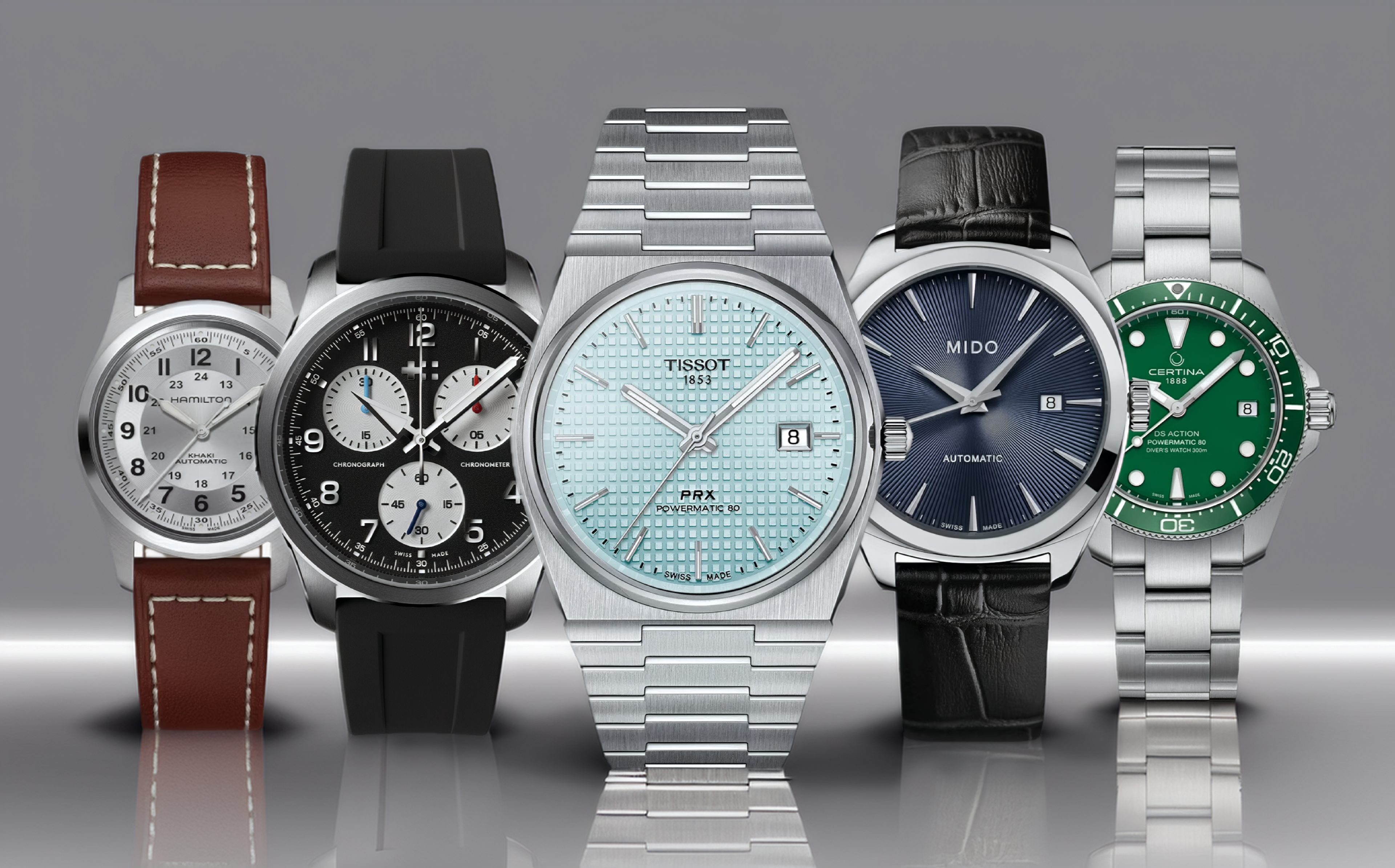
So, you’ve decided to move on from smartwatches and fashion brands. You want something with a beating heart—a mechanical soul. You want a Swiss automatic watch.
But when you type “best Swiss watch” into Google, you’re usually hit with five-figure price tags from Rolex, Omega, and Patek Philippe. It can feel like the “Swiss Made” club has an entry fee you can’t afford.
Here is the good news: It doesn’t.
In 2025, the sub-$1,000 category is arguably the most competitive and exciting space in horology. You can get genuine heritage, scratch-proof sapphire crystals, and 80-hour power reserves for less than the price of a new iPhone.
This guide is your roadmap. We will break down exactly what to look for, explain the jargon, and give you the definitive list of the best entry-level Swiss watches on the market today.
Part 1: What Does “Swiss Made” Actually Mean?
It’s not just a marketing slogan; it’s a law. For a watch to carry the “Swiss Made” label on the dial, it must meet specific criteria set by the Swiss government. Buying Swiss isn’t just about snobbery; it’s about buying into centuries of regulated quality control.
To qualify, a watch must meet these three pillars:
- The Movement: The internal engine must be Swiss.
- The Assembly: The movement must be cased up (put inside the watch) within Switzerland.
- The Inspection: The final quality control check must happen in Switzerland.
Part 2: The 3 “Must-Have” Specs
Don’t get distracted by flashy marketing or celebrity ambassadors. If you are spending $500–$1,000 of your hard-earned money, your watch must have these three features. If a brand tries to sell you a watch without them, walk away.
1. Sapphire Crystal
Cheaper watches use “Mineral Glass” or acrylic, which scratch if you look at them wrong. Sapphire is the second hardest material on earth (after diamond). You can drag your car keys across a sapphire crystal, and it won’t leave a mark.
- Pro Tip: Look for descriptions that mention “AR Coating” (Anti-Reflective). This stops the crystal from turning into a mirror under bright lights.
- Read more in our guide: Sapphire vs. Mineral Crystal: Why You Need to Know the Difference
2. A Solid Automatic Movement
At this price point, you don’t want a battery-powered quartz watch. You want an automatic movement that winds itself with the motion of your arm. You will likely encounter two main engine families:
- The Powermatic 80: Found in Tissot, Hamilton, and Certina. It beats slightly slower but offers a massive 80-hour power reserve. This means you can take the watch off on Friday evening, leave it on your dresser, and pick it up Monday morning—and it will still be running.
- The Sellita SW200: Found in Oris, Christopher Ward, and many microbrands. It has a smoother “sweep” (4Hz) but a shorter power reserve (38 hours).
3. Solid End Links (SEL)
If you buy a watch on a metal bracelet, check where the bracelet meets the watch head. If that connecting piece is hollow folded metal, it will jingle like a cheap toy and stretch over time. You want solid steel that is milled to fit the case perfectly.
Part 3: The Top 5 Entry-Level Swiss Watches (2025 Edition)
We have tested dozens of watches to bring you the best value-for-money contenders. These are the titans of the entry-level luxury world.
1. The Integrated Sports Choice: Tissot PRX Powermatic 80
If you have been on Instagram lately, you’ve seen this watch. The Tissot PRX revived the 1970s “integrated bracelet” trend (think Audemars Piguet Royal Oak) for a fraction of the price.
- The Vibe: Retro cool, disco era, sleek.
- Why it wins: The waffle dial texture is stunning, the bracelet reflects light like jewelry, and the Powermatic 80 movement is bulletproof.
- The Verdict: It is arguably the most important Swiss watch released in the last decade.
- Want the deep dive? Read our full review: Tissot PRX Powermatic 80 Review: Is It Still the Value King in 2025?
2. The Field Watch Icon: Hamilton Khaki Field Automatic
This is the watch that gets respect from everyone—from new collectors to guys who own $50,000 collections. It has genuine military heritage (Hamilton supplied the US military in WWII) and a rugged, no-nonsense design.
- The Vibe: Rugged, adventurous, “Tool Watch.”
- Why it wins: It looks better with scratches. It’s the ultimate “GADA” (Go Anywhere, Do Anything) watch.
- The Verdict: If you want a watch you never have to baby, this is it.
- See how it compares to its Japanese rival: Hamilton Khaki Field vs. Seiko Alpinist: Battle of the Field Watches
3. The Diver: Certina DS Action Diver
Certina is often overlooked in the US, but in Europe, it’s legendary. The “DS” stands for “Double Security,” meaning this watch is built like a tank with extra O-rings and shock protection.
- The Vibe: Professional, aquatic, robust.
- Why it wins: It is ISO 6425 certified, which means it is a legally official professional dive watch. It features a ceramic bezel (scratch-proof) and a clasp with on-the-fly adjustment—features usually reserved for watches costing twice as much.
4. The Dress Watch: Tissot Le Locle (or Mido Baroncelli)
If you wear a suit to work, you don’t want a bulky diver sliding out from your cuff. The Tissot Le Locle is named after Tissot’s hometown in the Swiss Jura mountains.
- The Vibe: Elegant, traditional, timeless.
- Why it wins: It features a classic Clous de Paris (hobnail) dial texture that looks incredibly expensive. It’s thin, elegant, and instantly signals sophistication.
5. The “Wildcard”: Christopher Ward (The Microbrand King)
Okay, technically Christopher Ward is a British brand, but their watches are “Swiss Made” and assembled in Biel/Bienne. They operate on a direct-to-consumer model, meaning they cut out the middleman markup.
- The Vibe: Modern, high-spec, value-driven.
- Why it wins: Their Trident divers offer finishing that rivals Omega for a third of the price. The “Light-Catcher” case is a work of art.
- Curious about non-mainstream brands? Check out our list of 5 Swiss Microbrands That Offer Better Specs Than Longines.
Part 4: Buying Advice (Gray Market vs. AD)
When you are ready to buy, you will see two prices online.
- Authorized Dealer (AD): The official price. You get the full manufacturer warranty (usually 2 years).
- Gray Market (Jomashop, etc.): A discounted price (often 20-30% off). You do not get the manufacturer warranty; you get the shop’s warranty.
Our Advice: For a sub-$1,000 watch, the savings on the Gray Market can be significant. Since these movements (Powermatic 80, SW200) are reliable and easy to fix, buying gray market is often a safe bet to save $200. However, if you want total peace of mind, stick to an Authorized Dealer.
Final Thoughts: The “One Watch” Philosophy
The best watch isn’t the most expensive one; it’s the one you actually wear.
If you work in an office and want something versatile, the Tissot PRX is likely your best bet. If you hike, camp, and work with your hands, the Hamilton Khaki Field will serve you better.
Don’t overthink it. The sub-$1,000 Swiss market has never been better. Pick the one that makes you smile when you check the time.
Ready to dig deeper?
- Detailed Review: Tissot PRX Powermatic 80 Review
- Head-to-Head: Hamilton Khaki vs. Seiko Alpinist
- Microbrand Guide: 5 Rising Swiss Microbrands